PROTECTED SOURCE SCRIPT
[ARTIO] TTGv65: The Grail (Pro Alerts + Custom %)
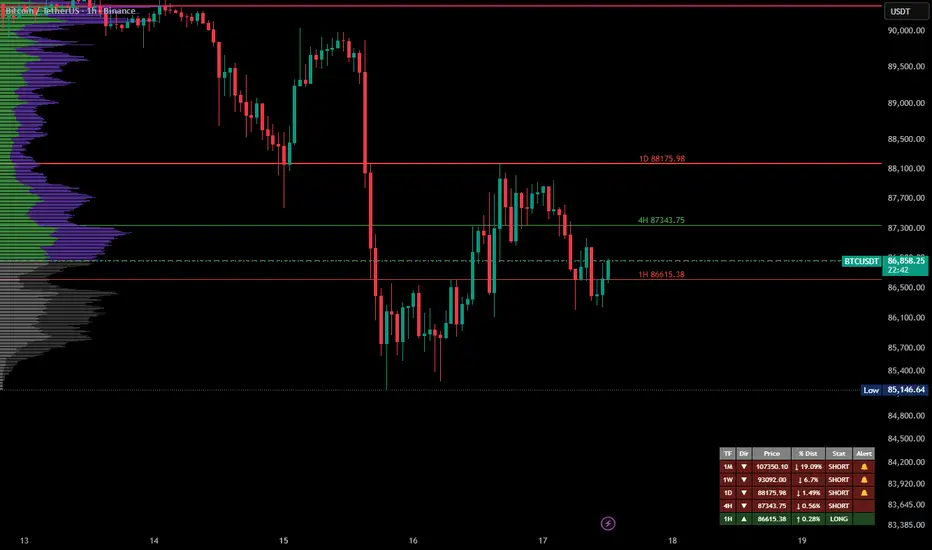
Instructions: What is TVR and how to move it?
1. What is TVR?
Imagine that TVR is a concrete wall that protects your profit.
If we are growing (LONG) - the wall is below (Floor). The price bounces off the floor upwards.
If we are falling (SHORT) - the wall is above (Ceiling). The price hits its head against the ceiling and falls down.
Your task: Move this wall along with the price to "squeeze" the market, but never prevent the price from breathing.
2. The main secret: "The Hot Lava Rule" (No-Touch)
This is where beginners "fail". Remember one rule:
We only touch the TVR when there is AIR between the Candle and the Line.
Imagine that the TVR line is molten lava.
If the candle (with its body or even the tip of its wick) touches the line - HANDS OFF! Don't touch anything. Wait. A battle is underway.
We only move the line when the candle has completely DETACHED from the lava and closed.
3. Algorithm of actions (How to move it manually)
Scenario A: We are in a LONG position (Price is rising, Line is below)
You sit and wait for the hour to close (or your timeframe). The candle has closed. Look at it:
Does it touch the line? (With its wick or body).
YES: Sit still. The line stays in place.
NO: Excellent, "Air" has appeared!
Where is its low (Low)?
Take your line and move it to the very bottom (Low) of this candle.
Important: In a Long position, the line can only be moved UP. If the new candle has detached, but its low is below the old line - this is impossible (it means it broke through the line, see Scenario B). Scenario B: We are SHORT (Price is falling, Line is above)
The candle has closed. You look:
Does it touch the line?
YES: Don't touch it. The lava burns your hands.
NO: There's "Air"! The candle is completely below the line.
Where is its top (High)?
Take the line and lower it to the very top (High) of this candle.
Important: In a Short position, we only move DOWN.
4. Scenario C: "Trend Change" (Breakout)
This is the moment when the floor becomes the ceiling (or vice versa).
How do you know that the trend has changed? The candle must boldly jump over the line and close completely on the other side. It should not have any contact with the previous line.
Was LONG (Line below): Suddenly a "nasty" red candle closes, which is entirely (both body and upper wick) BELOW our line. 👉 Action: This is a Short. Take the line and place it on the High of this candle. Now this is your Ceiling.
Was SHORT (Line above): Suddenly a green candle shoots up, which has completely (including the bottom) gone ABOVE our line. 👉 Action: This is a Long. Take the line and place it below the Low of this candle. Now this is your Floor.
Summary for a sticker on your monitor:
Wait for the candle to close. (While it's blinking, it's a deception).
Is there contact? -> Do nothing.
Is there a gap (Air)? -> Move the line following the price (below the Low in a Long / on the High in a Short).
Complete jump over the line? -> Change the trend (Long ↔ Short).
1. What is TVR?
Imagine that TVR is a concrete wall that protects your profit.
If we are growing (LONG) - the wall is below (Floor). The price bounces off the floor upwards.
If we are falling (SHORT) - the wall is above (Ceiling). The price hits its head against the ceiling and falls down.
Your task: Move this wall along with the price to "squeeze" the market, but never prevent the price from breathing.
2. The main secret: "The Hot Lava Rule" (No-Touch)
This is where beginners "fail". Remember one rule:
We only touch the TVR when there is AIR between the Candle and the Line.
Imagine that the TVR line is molten lava.
If the candle (with its body or even the tip of its wick) touches the line - HANDS OFF! Don't touch anything. Wait. A battle is underway.
We only move the line when the candle has completely DETACHED from the lava and closed.
3. Algorithm of actions (How to move it manually)
Scenario A: We are in a LONG position (Price is rising, Line is below)
You sit and wait for the hour to close (or your timeframe). The candle has closed. Look at it:
Does it touch the line? (With its wick or body).
YES: Sit still. The line stays in place.
NO: Excellent, "Air" has appeared!
Where is its low (Low)?
Take your line and move it to the very bottom (Low) of this candle.
Important: In a Long position, the line can only be moved UP. If the new candle has detached, but its low is below the old line - this is impossible (it means it broke through the line, see Scenario B). Scenario B: We are SHORT (Price is falling, Line is above)
The candle has closed. You look:
Does it touch the line?
YES: Don't touch it. The lava burns your hands.
NO: There's "Air"! The candle is completely below the line.
Where is its top (High)?
Take the line and lower it to the very top (High) of this candle.
Important: In a Short position, we only move DOWN.
4. Scenario C: "Trend Change" (Breakout)
This is the moment when the floor becomes the ceiling (or vice versa).
How do you know that the trend has changed? The candle must boldly jump over the line and close completely on the other side. It should not have any contact with the previous line.
Was LONG (Line below): Suddenly a "nasty" red candle closes, which is entirely (both body and upper wick) BELOW our line. 👉 Action: This is a Short. Take the line and place it on the High of this candle. Now this is your Ceiling.
Was SHORT (Line above): Suddenly a green candle shoots up, which has completely (including the bottom) gone ABOVE our line. 👉 Action: This is a Long. Take the line and place it below the Low of this candle. Now this is your Floor.
Summary for a sticker on your monitor:
Wait for the candle to close. (While it's blinking, it's a deception).
Is there contact? -> Do nothing.
Is there a gap (Air)? -> Move the line following the price (below the Low in a Long / on the High in a Short).
Complete jump over the line? -> Change the trend (Long ↔ Short).
Script protégé
Ce script est publié en source fermée. Cependant, vous pouvez l'utiliser librement et sans aucune restriction – pour en savoir plus, cliquez ici.

Clause de non-responsabilité
Les informations et publications ne sont pas destinées à être, et ne constituent pas, des conseils ou recommandations financiers, d'investissement, de trading ou autres fournis ou approuvés par TradingView. Pour en savoir plus, consultez les Conditions d'utilisation.
Script protégé
Ce script est publié en source fermée. Cependant, vous pouvez l'utiliser librement et sans aucune restriction – pour en savoir plus, cliquez ici.
Clause de non-responsabilité
Les informations et publications ne sont pas destinées à être, et ne constituent pas, des conseils ou recommandations financiers, d'investissement, de trading ou autres fournis ou approuvés par TradingView. Pour en savoir plus, consultez les Conditions d'utilisation.