OPEN-SOURCE SCRIPT
QUANT TRADING ENGINE [PointAlgo]
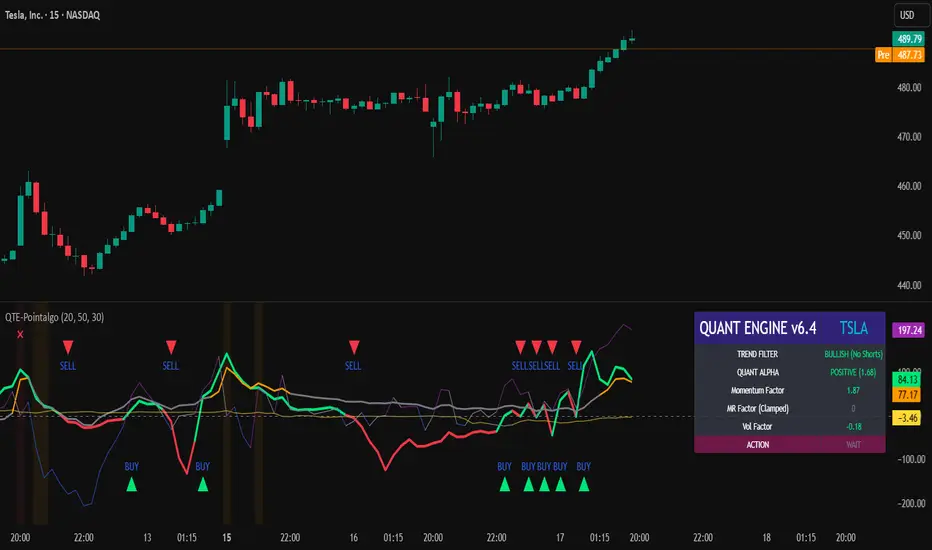
Quant Trading Engine is a quantitative market-analysis indicator that combines multiple statistical factors to study trend behavior, mean reversion, volatility, execution efficiency, and market stability.
The indicator converts raw price behavior into standardized signals to help evaluate directional bias and risk conditions in a systematic way.
This script focuses on factor alignment and regime awareness, not prediction certainty.
Design Philosophy
Markets move through different regimes such as trending, ranging, volatile expansion, and instability.
This indicator attempts to model these regimes by blending:
Each component is normalized and combined into a single Quant Alpha framework.
Factor Construction
1. Momentum Factor
2. Mean Reversion Factor
Directional Clamping
Mean-reversion signals are dynamically restricted:
This prevents conflicting signals in strong trends.
3. Volatility Factor
4. Composite Quant Alpha
The final Quant Alpha is a weighted blend of:
The composite is standardized into a Z-score, allowing consistent interpretation across instruments and timeframes.
Signal Logic
Signals reflect statistical regime change, not trade instructions.
Volatility Smile Context
Exotic Risk Conditions
Execution Context (VWAP)
Correlation Structure
Visualization
The indicator plots:
Dashboard
A compact dashboard summarizes:
The dashboard provides a real-time snapshot of internal model conditions.
Usage Notes
Disclaimer
This script is provided for educational and analytical purposes only.
It does not provide financial, investment, or trading advice.
All outputs should be independently validated before making any trading decisions.
The indicator converts raw price behavior into standardized signals to help evaluate directional bias and risk conditions in a systematic way.
This script focuses on factor alignment and regime awareness, not prediction certainty.
Design Philosophy
Markets move through different regimes such as trending, ranging, volatile expansion, and instability.
This indicator attempts to model these regimes by blending:
- Momentum strength
- Mean-reversion pressure
- Volatility risk
- Trend filtering
- Execution context (VWAP)
- Correlation structure
Each component is normalized and combined into a single Quant Alpha framework.
Factor Construction
1. Momentum Factor
- Measures directional strength using percentage price change over a rolling window.
- Standardized using mean and standard deviation.
- Represents trend continuation pressure.
2. Mean Reversion Factor
- Measures deviation from a longer moving average.
- Standardized to identify stretched conditions.
- Designed to capture counter-trend behavior.
Directional Clamping
Mean-reversion signals are dynamically restricted:
- No counter-trend buying during downtrends.
- No counter-trend selling during uptrends.
- Allows both sides only in neutral regimes.
This prevents conflicting signals in strong trends.
3. Volatility Factor
- Uses realized volatility derived from price changes.
- Penalizes environments where volatility deviates significantly from its norm.
- Acts as a risk adjustment rather than a directional driver.
4. Composite Quant Alpha
The final Quant Alpha is a weighted blend of:
- Momentum
- Mean reversion (trend-clamped)
- Volatility risk
The composite is standardized into a Z-score, allowing consistent interpretation across instruments and timeframes.
Signal Logic
- Buy signal occurs when Quant Alpha crosses above zero.
- Sell signal occurs when Quant Alpha crosses below zero.
- Zero-cross logic is used to represent shifts from negative to positive statistical bias and vice versa.
Signals reflect statistical regime change, not trade instructions.
Volatility Smile Context
- Measures price deviation from its statistical distribution.
- Identifies skewed conditions where upside or downside volatility becomes dominant.
- Highlights extreme deviations that may imply elevated derivative risk.
Exotic Risk Conditions
- Detects sudden price expansion combined with volatility spikes.
- Highlights environments where execution and risk become unstable.
- Visual background cues are used for awareness only.
Execution Context (VWAP)
- Measures price distance from VWAP.
- Used to assess execution efficiency rather than direction.
- Helps identify stretched conditions relative to average traded price.
Correlation Structure
- Evaluates short-term return correlations.
- Detects when price behavior becomes less predictable.
- Flags structural instability rather than trend direction.
Visualization
The indicator plots:
- Quant Alpha (scaled) with directional coloring
- Volatility smile deviation
- Price vs VWAP distance
- Correlation structure
Dashboard
A compact dashboard summarizes:
- Trend filter state
- Quant Alpha polarity and value
- Individual factor readings
- Current action state (Buy / Sell / Wait / Risk)
The dashboard provides a real-time snapshot of internal model conditions.
Usage Notes
- Designed for analytical interpretation and research.
- Best used alongside price action and risk management tools.
- Factor behavior depends on instrument liquidity and volatility.
- Not optimized for illiquid or irregular markets.
Disclaimer
This script is provided for educational and analytical purposes only.
It does not provide financial, investment, or trading advice.
All outputs should be independently validated before making any trading decisions.
Script open-source
Dans l'esprit TradingView, le créateur de ce script l'a rendu open source afin que les traders puissent examiner et vérifier ses fonctionnalités. Bravo à l'auteur! Bien que vous puissiez l'utiliser gratuitement, n'oubliez pas que la republication du code est soumise à nos Règles.

Unlock powerful tools & indicators → pointalgo.com
Clause de non-responsabilité
Les informations et publications ne sont pas destinées à être, et ne constituent pas, des conseils ou recommandations financiers, d'investissement, de trading ou autres fournis ou approuvés par TradingView. Pour en savoir plus, consultez les Conditions d'utilisation.
Script open-source
Dans l'esprit TradingView, le créateur de ce script l'a rendu open source afin que les traders puissent examiner et vérifier ses fonctionnalités. Bravo à l'auteur! Bien que vous puissiez l'utiliser gratuitement, n'oubliez pas que la republication du code est soumise à nos Règles.
Unlock powerful tools & indicators → pointalgo.com
Clause de non-responsabilité
Les informations et publications ne sont pas destinées à être, et ne constituent pas, des conseils ou recommandations financiers, d'investissement, de trading ou autres fournis ou approuvés par TradingView. Pour en savoir plus, consultez les Conditions d'utilisation.